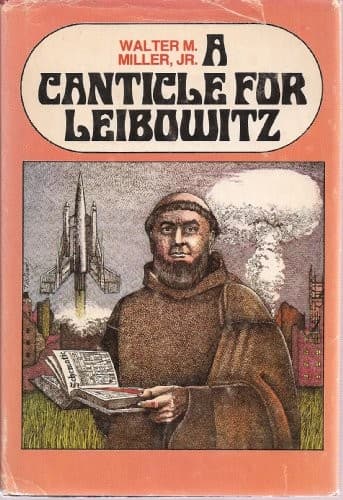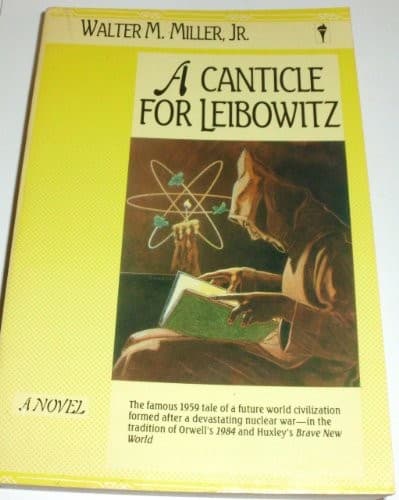
In a nightmarish ruined world slowly awakening to the light after sleeping in darkness, the infant rediscoveries of science are secretly nourished by cloistered monks dedicated to the study and preservation of the relics and writings of the blessed Saint Isaac Leibowitz. From here the story spans centuries of ignorance, violence, and barbarism, viewing through a sharp, satirical eye the relentless progression of a human race damned by its inherent humanness to recelebrate its grand foibles and repeat its grievous mistakes.
Add to your library to track progress and write reviews
Find A Canticle for Leibowitz Walter M. Miller Jr. in PDF, EPUB, ebook, audiobook, print, or library editions.
3 books in catalog
Post-apocalyptic science fiction was profoundly shaped by a vision of monastic preservation after nuclear devastation in A Canticle for Leibowitz. American author Walter M. Miller Jr. constructed a sweeping multi-century chronicle in which Catholic monks preserve human scientific knowledge through a new Dark Age following a global nuclear holocaust. The novel won the 1961 Hugo Award for Best Novel and remains one of the seminal works of mid-twentieth-century speculative fiction.
Before publishing his celebrated novel, Miller established himself during the 1950s through dozens of short stories and novellas across major genre magazines. His fiction frequently explored the psychological fallout of war, religious faith, technological hubris, and the survival of human culture across vast stretches of historical time.
Born on January 23, 1923, in New Smyrna Beach, Florida, Walter Michael Miller Jr. served as a flight crewman and radioman-gunner in the United States Army Air Forces during World War II. Flying combat missions over Europe, he participated in the 1944 bombing raid that destroyed the ancient Benedictine abbey at Monte Cassino—an experience that left a lasting impression on his view of warfare, destruction, and spiritual heritage. After his military service, Miller converted to Catholicism in 1947 and studied engineering before turning to writing.
Miller launched his professional writing career in 1951 with the publication of Secret of the Death Dome in Amazing Stories. Over the next decade, he published approximately forty short stories and novellas in leading science fiction periodicals, including Galaxy, Astounding Science Fiction, and The Magazine of Fantasy and Science Fiction. His notable short fiction included Dark benediction in 1951, a story dealing with an alien plague and physical transformation. In the late 1950s, Miller adapted three connected novellas into A Canticle for Leibowitz, which was published in 1959 and became his only novel released during his lifetime.
Miller's writing is recognized for its intellectual depth, moral complexity, and serious engagement with religious, philosophical, and historical questions. Moving beyond the action-oriented tropes common in pulp science fiction, Miller examined the cyclical nature of human rise and fall, the ethical dilemmas of technological progress, and the role of religious institutions in safeguarding culture during societal collapse. His prose combined sharp satire with grave reflection on human fallibility.
A central theme in Miller's work is the preservation of human record and identity through dark ages. In his most famous fictional setting, the Albertian Order of Leibowitz painstakingly preserves technical schematics and fragments of ancient knowledge without fully comprehending their original purpose. Late in life, Miller returned to this fictional setting to write a long-planned companion novel, Saint Leibowitz and the Wild Horse Woman, which was published posthumously following his death on January 9, 1996.
St. Leibowitz