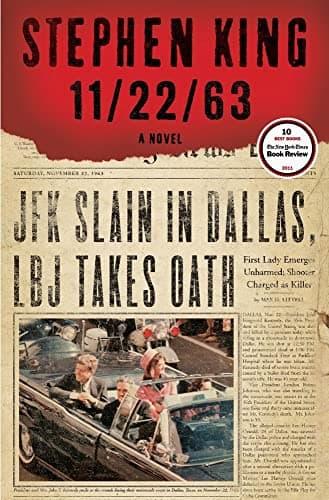
The past is not a passive memory; it is an obdurate, living force that actively resists being altered. When Jake Epping, a high school English teacher in Maine, is shown a temporal "rabbit hole" in a local diner’s pantry, he is confronted with the ultimate ethical dilemma of the twentieth century. His mission, inherited from a dying friend, is to inhabit the past for five years to prevent the assassination of John F. Kennedy. It is a quest built on the premise that saving one man might steer a fractured world away from the tragedies of Vietnam and the civil unrest that followed.
However, the mechanics of this journey are governed by a set of rigid, unforgiving rules. Every time Jake steps through the portal, it is always September 9, 1958, at 11:58 a.m. Every trip resets the timeline entirely, erasing any previous changes. This creates a psychological burden of permanence: to change the future, Jake must commit to years of living a double life in a world that feels more vibrant, tastes better, and costs less, yet pulses with an underlying hostility toward anyone trying to change its course.
The world-building in this narrative focuses on the physical and metaphysical weight of history. The 1950s are not presented through a lens of pure nostalgia; instead, the atmosphere is defined by sensory density—the smell of leaded gasoline, the clink of glass root beer bottles, and the pervasive "harmony" of the timeline. The setting operates on the principle that the past is "obdurate"—it does not want to be changed. The more significant the intended alteration, the more the universe pushes back through "coincidences," accidents, and physical ailments designed to keep the traveler away from their goal. This creates a unique brand of suspense where the antagonist is not necessarily a person, but the fabric of time itself.
Jake Epping begins the story as a man with few attachments: a divorced teacher whose most significant connection is his empathy for an adult education student, Harry Dunning. Jake’s initial character arc is defined by this empathy. Before he ever attempts to save the President, he undergoes a "test run" to prevent a localized tragedy involving the Dunning family in 1958. To survive and blend in, Jake must shed his modern identity and become George Amberson. This transition requires a meticulous adoption of mid-century social norms, dialects, and lifestyles. His relationship with the past is complicated by his role as a "man out of time," struggling to maintain his 21st-century morality while navigating the complex social hierarchies and prejudices of the pre-Civil Rights era.
While the book utilizes the common "historical fix-it" trope—the idea that one man can save the world by changing one event—it subverts this by focusing on the "Butterfly Effect" and the law of unintended consequences. Unlike many science fiction stories that treat time travel as a technical problem to be solved with gadgets, this narrative treats it as a moral and philosophical weight. It explores the trope of the "Town with a Dark Secret" during Jake’s early tenure in Derry, Maine, where the atmosphere is thick with a malevolence that suggests some historical traumas are too deep to be simply "fixed." The focus remains on the logistical and emotional cost of surveillance, as Jake must spend years tracking Lee Harvey Oswald, questioning whether the ends truly justify the erosion of his own life in the present.
Add to your library to track progress and write reviews
Find 11/22/63 Stephen King in PDF, EPUB, ebook, audiobook, print, or library editions.

38 books in catalog
Stephen Edwin King was born the second son of Donald and Nellie Ruth Pillsbury King. After his father left them when Stephen was two, he and his older brother, David, were raised by his mother.
He is widely known for his horror novels, he has been crowned the "King of Horror". He has also explored other genres, among them suspense, crime, science-fiction, fantasy and mystery.