WS
§Author· 1 book
William Strunk Jr.
Also known as William Strunk, William Strunk, Jr.
Clear, direct instruction on language usage form the bedrock of American writing pedagogy, most famously codified in a slender handbook originally created for college students. William Strunk Jr. created a practical reference manual that simplified grammar and sentence structure into actionable principles, transforming how students and professionals approach composition. First printed privately for his classroom at Cornell University, The Elements of Style became one of the most widely assigned style manuals in English education.
Career & Background
Born on July 1, 1869, in Cincinnati, Ohio, William Strunk Jr. spent his professional life in academia as a scholar of English literature and language. He served as a longtime professor of English at Cornell University in Ithaca, New York. In 1918, Strunk privately published a 43-page textbook titled The Elements of Style to serve as a concise reference guide for his student courses. He later expanded on his pedagogical framework in 1935 by coauthoring The Elements and Practice of Composition with Edward A. Tenney. Strunk remained an active educator at Cornell until his retirement, later passing away on September 26, 1946, in Poughkeepsie, New York.
The ongoing influence of Strunk's work owes much to his former Cornell student, the writer E. B. White. Decades after taking Strunk's course, White published an essay in The New Yorker recalling his professor's passionate insistence on brevity and precision. The article prompted Macmillan to publish a revised commercial trade edition in 1959. Featuring revisions and additions by White, the coauthored volume—informally known as Strunk & White—became a staple reference work across high school and university writing curricula.
Writing Style & Themes
Strunk's approach to composition focused on structural discipline, clarity, and economic expression. Rather than burdening writers with complex grammatical theory, his instruction prioritized functional, plain-spoken rules designed to purge unnecessary words from prose. Strunk advocated for active verbs over passive phrasing, concise clause structure, and parallel grammatical forms, famously summarizing his primary philosophy as a directive to omit needless words.
Major Works
- The Elements of Style — Privately printed in 1918 as a concise textbook for Cornell University students, this foundational writing manual outlines essential rules of usage and elementary principles of composition. It gained broad commercial influence following its 1959 revision by E. B. White.
- The Elements and Practice of Composition — Coauthored with Edward A. Tenney in 1935, this enlarged textbook adapted Strunk's core composition rules into a broader instructional format for university classroom study.
§All Books
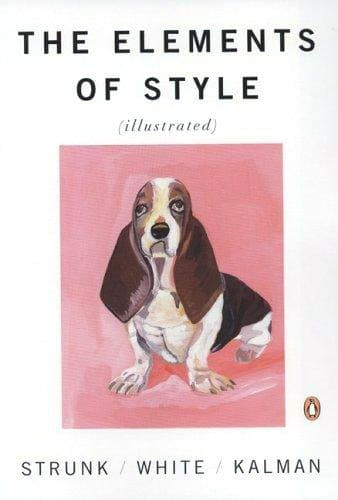
The Elements of Style
William Strunk Jr.
133 ratings