Voltaire
Also known as François-Marie Arouet, François-Marie d'Arouet, François-Marie Arouet de Voltaire
Eighteenth-century French philosophical fiction transformed political and social debate through biting satire and accessible storytelling, most famously in the novella Candide. Writing under the pen name Voltaire, François-Marie Arouet challenged religious dogma, state censorship, and philosophical optimism while producing an extraordinary body of work spanning thousands of essays, plays, poems, and letters.
His sharp polemical narratives served as a foundational voice in Enlightenment thought, attacking clerical corruption and championing civil liberties, freedom of religion, and freedom of speech. By pairing philosophical inquiry with popular literary forms, his writings exposed institutional injustice and directly shaped the intellectual climate that preceded the American and French Revolutions.
Career & Background
Born François-Marie Arouet in Paris in 1694 to a prosperous bourgeois family, he received a rigorous education as a pupil of the Jesuits. Despite his father's attempts to guide him into a career in the law, he rejected legal studies to pursue writing. In 1718, he adopted the pen name Voltaire, an anagram derived from 'Arouet l(e) j(eune)'. His politically charged writing quickly drew the ire of French authorities, resulting in two imprisonments in the Bastille and extended periods of exile from France across a career spanning over six decades.
Despite strict censorship laws and harsh legal penalties for political dissent, Voltaire built an expansive literary output comprising an estimated fifteen million words. Over his lifetime, he produced more than 20,000 letters and over 2,000 books and pamphlets. His vast range of genres encompassed dramatic works such as the tragic play Zaïre, historical studies like The Age of Louis XIV, scientific expositions, and philosophical tracts. He spent much of his mature life living near the French border or abroad before returning to Paris shortly before his death in 1778.
Writing Style & Themes
As a satirical polemicist, Voltaire deployed wit, irony, and philosophical dialogue to criticize religious intolerance, clerical power, institutional corruption, and the abuses of the French monarchy. He stood alongside Enlightenment thinkers such as Montesquieu, John Locke, and Jean-Jacques Rousseau in advocating for social reform, free trade, freedom of speech, freedom of religion, and the separation of church and state, while also voicing explicit criticism of slavery.
Voltaire's literary technique prioritized clarity, swift narrative pacing, and accessible prose to engage popular readers with complex philosophical questions. Rather than constructing abstract metaphysical systems, he used storytelling to dismantle rigid doctrines, exposing hypocrisy and advocating for pragmatic social justice through irony and vivid character encounters.
Major Works
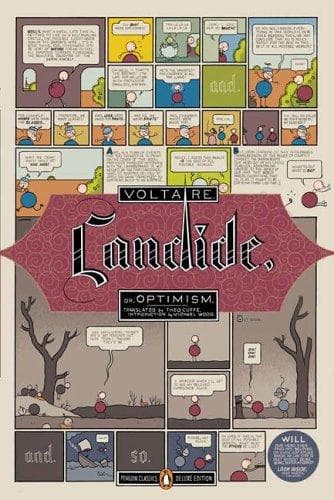
- Candide — A 1759 satirical novella following the global misadventures of a naive young man, using swift narrative irony to mock philosophical optimism, religious hypocrisy, and institutional abuses.
- Zaïre — A 1732 tragic play set during the Crusades that explores themes of jealousy, religious conflict, and cross-cultural prejudice.
- The Age of Louis XIV — A historical study analyzing seventeenth-century French political, cultural, and military developments, reflecting Voltaire's role as an influential historian.