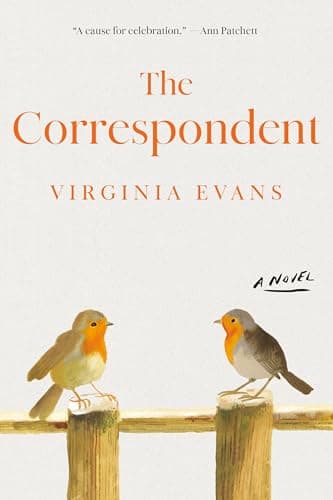
Virginia Evans
An epistolary novel centered on personal transformation and human connection, The Correspondent became a word-of-mouth bestseller that earned widespread literary acclaim. Written by American novelist Virginia Evans, the debut work reached the top of The New York Times Best Seller list and won the 2026 Women's Prize for Fiction.
The novel explores how an individual experiences profound personal change at a point when transformation had seemed nearly impossible, utilizing letters and subtle humor to capture quiet emotional depth.
Career & Background
Evans was born in South Carolina on June 2, 1986, and spent her childhood across the East Coast of the United States, including Philadelphia and Severna Park, Maryland. She earned her bachelor's degree in English literature from James Madison University. After starting a family, she returned to school to pursue a Master of Philosophy in creative writing at Trinity College Dublin in Ireland. During her graduate studies, she trained under notable authors and poets including Claire Keegan, Kevin Power, Carlo Gébler, Eoin McNamee, and Harry Clifton. She currently resides in Winston-Salem, North Carolina, with her husband, Mark, their two children, Jack and Mae, and her Red Labrador, Brigid.
Although Evans began writing fiction two decades prior to her major publishing milestone, her path involved a long period of quiet persistence before achieving commercial success. Her debut novel, The Correspondent, was published in 2025. The book rapidly gained momentum through book club recommendations, eventually rising to the top of bestseller lists and earning international award recognition.
Writing Style & Themes
Growing up, Evans developed an early appreciation for storytelling through mystery novels and imaginative fiction, including the Nancy Drew series, Gertrude Chandler Warner's mystery books, C.S. Lewis's Narnia series, and Kenneth Grahame's The Wind in the Willows. During her undergraduate studies in English and creative writing, reading Jhumpa Lahiri's short story collection Interpreter of Maladies served as a pivotal influence by demonstrating the power of precise language, while Joan Didion's prose also shaped her approach to craft.
In her own work, Evans utilizes epistolary structures to build intimate, character-focused narratives marked by gentle humor and emotional authenticity. Through the device of handwritten correspondence and personal reflections, her narrative examines recurring themes of patience, resilience, personal transition, and the capacity for renewal later in life.
Major Works
- The Correspondent — Published in 2025, this debut epistolary novel explores personal growth and life-changing perspective through written letters. The book grew into a major word-of-mouth success, reached number one on The New York Times Best Seller list, and won the 2026 Women's Prize for Fiction.