
§Author· 1 book
Viktor E. Frankl
Also known as Viktor Emil Frankl
The psychological framework proposing that human motivation stems primarily from a search for meaning rather than pleasure or power revolutionized twentieth-century existential psychiatry, a concept famously detailed in Man's Search for Meaning. Viktor Frankl, an Austrian neurologist, psychiatrist, and Holocaust survivor, established this approach through his clinical practice and personal endurance in Nazi concentration camps.
Across thirty-nine books, Frankl developed logotherapy and existential analysis to provide readers and clinicians with practical tools for understanding personal resilience, responsibility, and human purpose.
Career & Background
Born in Vienna, Austria, on March 26, 1905, Viktor Emil Frankl developed an early interest in psychiatry and socialist youth organizations. At age sixteen, he began corresponding with Sigmund Freud and published an early scientific paper three years later. Frankl earned his medical degree from the University of Vienna in 1930 and subsequently oversaw hospital wards handling depressed patients. Between 1940 and 1942, he served as head of the Neurology Department at Vienna's Rothschild Hospital. During World War II, Frankl was deported by Nazi authorities and spent three years imprisoned in concentration camps, including Auschwitz and Dachau.
Following his liberation, Frankl earned his doctorate in philosophy from the University of Vienna in 1949 and served as director of the Vienna Neurological Policlinic from 1946 to 1970. He spent decades as professor of neurology and psychiatry at the University of Vienna Medical School while holding visiting professorships in the United States at institutions such as Harvard University, Stanford University, Southern Methodist University in Dallas, the University of Pittsburgh, and U.S. International University in San Diego. Frankl continued lecturing and publishing until his death in Vienna on September 2, 1997.
Writing Style & Themes
Frankl's professional and autobiographical writings integrate psychiatric rigor with existential philosophy, presenting clear analyses of human motivation and resilience. His foundational contribution, logotherapy, is widely recognized as the "Third Viennese School of Psychotherapy" following Sigmund Freud's psychoanalysis and Alfred Adler's individual psychology. Central to Frankl's perspective is the principle that humans are driven by a fundamental desire to discover meaning in existence.
In his works, Frankl addresses existential frustration, personal responsibility, and the human capacity to withstand suffering. He argued that meaning can be realized in three primary ways: through creating work or accomplishing a task, through experiencing goodness or relationships, and through adopting a courageously chosen attitude when facing unavoidable suffering.
Major Works
- Man's Search for Meaning — An influential autobiographical account detailing Frankl's observations as a prisoner in Nazi concentration camps alongside an introduction to the tenets of logotherapy.
- Viktor Frankl - Recollections. An Autobiography — A memoir reflecting on Frankl's early years in Vienna, his academic trajectory, intellectual development, and life experiences.
§All Books
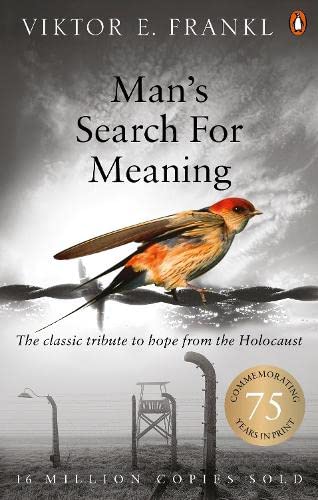
Man's Search for Meaning
Viktor E. Frankl, 1946
966 ratings
§ About Viktor E. Frankl's books
- Books on SansFiction
- 1
- Published
- 1946
- Average rating
- 4.2 / 5 across 966 ratings
- Genres
- Biography & Autobiography, Classics, Concentration Camp Inmates, Existential Psychotherapy
The book: Man's Search for Meaning (1946)
Psychiatrist Viktor Frankl's memoir has riveted generations of readers with its descriptions of life in Nazi death camps and its lessons for spiritual survival. Based on his own experience and the stories of his patients, Frankl argues that we cannot avoid suffering but we can choose how to cope with it, find meaning in it, and move forward with renewed…
Common questions about Viktor E. Frankl
- Who is Viktor E. Frankl?
- Born in Vienna, Austria, on March 26, 1905, Viktor Emil Frankl developed an early interest in psychiatry and socialist youth organizations. At age sixteen, he began corresponding with Sigmund Freud and published an early scientific paper three years later. Frankl earned his medical degree from the University of Vienna in 1930 and subsequently oversaw hospital wards handling depressed patients.
- What is Viktor E. Frankl best known for?
- Viktor E. Frankl is best known for Man's Search for Meaning, published in 1946 with 966 ratings and a 4.2 average. It is the most-rated of Viktor E. Frankl's books on SansFiction.
- What genres does Viktor E. Frankl write?
- Viktor E. Frankl's books on SansFiction are tagged Biography & Autobiography, Classics, Concentration Camp Inmates and Existential Psychotherapy.
Explore: Biography & Autobiography · Classics · Concentration Camp Inmates · Existential Psychotherapy