
§Author· 3 books
Umberto Eco
Historical mysteries enriched by semiotics, medieval philosophy, and literary theory brought intellectual rigor to popular fiction through the international success of The Name of the Rose. Italian scholar and philosopher Umberto Eco transformed dense academic concepts into engaging narrative fiction, crafting complex mysteries that blend historical detail, biblical analysis, and philosophical enquiry.
Career & Background
Born in Alessandria, Italy, in 1932, Eco completed his classical secondary education before enrolling at the University of Turin, where he graduated in 1954 with a degree in philosophy. His academic career focused on aesthetics, communication, and semiotics, leading to landmark theoretical publications such as The Open Work (1962) and A Theory of Semiotics (1976). He served as a professor of semiotics at the University of Bologna, president of the Graduate School for the Study of the Humanities at Bologna, and founded the Department of Media Studies at the University of the Republic of San Marino. In addition to his academic posts, he was a member of the Accademia dei Lincei and an honorary fellow of Kellogg College, Oxford. Alongside his scholarly output, Eco wrote essays, children's books, and translations, including an Italian translation of Raymond Queneau's Exercises in Style in 1983. He passed away in 2016.
Writing Style & Themes
Eco's fiction is distinguished by its deep engagement with semiotics, textual interpretation, and the boundary between reality and fiction. His narratives frequently feature erudite protagonists navigating intricate historical landscapes, secret societies, and complex philosophical dilemmas. Through playful irony, intertextual references, and postmodern structural techniques, Eco challenged readers to examine how meaning is constructed, interpreted, and manipulated, often interrogating the nature of truth and the dangerous allure of conspiracy theories.
Major Works
- The Name of the Rose — Published in 1980 as Il nome della rosa, this 14th-century monastic murder mystery combines medieval studies, biblical analysis, and semiotics as a Franciscan friar investigates a series of unexplained deaths.
- Foucault's Pendulum — Originally published in 1988 as Il pendolo di Foucault, this novel touches on hermeticism, secret societies, and the dangerous consequences of constructing fictional conspiracy theories.
- The Prague Cemetery — Released in 2010 as Il cimitero di Praga, this novel follows a 19th-century secret agent and conspirator involved in forgery and espionage across Europe, topping bestseller charts in Italy.
§All Books
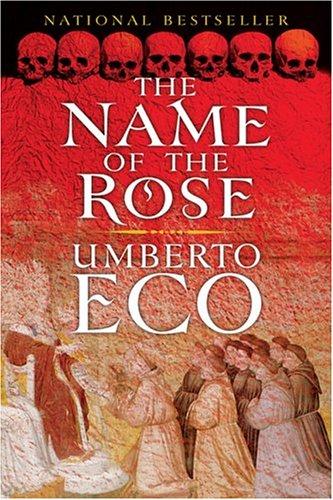
The Name of the Rose
Umberto Eco, 1980
522 ratings

Foucault's Pendulum
Umberto Eco, 1988
169 ratings

The Prague Cemetery
Umberto Eco, 2010
37 ratings
§ About Umberto Eco's books
- Books on SansFiction
- 3
- Published
- 1980–2010
- Average rating
- 4.0 / 5 across 728 ratings
- Genres
- History, Classics, Detective And Mystery Stories, Historical Fiction
Start here: The Name of the Rose (1980)
The year is 1327. Franciscans in a wealthy Italian abbey are suspected of heresy, and Brother William of Baskerville arrives to investigate. When his delicate mission is suddenly overshadowed by seven bizarre deaths, Brother William turns detective.
Common questions about Umberto Eco
- Who is Umberto Eco?
- Born in Alessandria, Italy, in 1932, Eco completed his classical secondary education before enrolling at the University of Turin, where he graduated in 1954 with a degree in philosophy. His academic career focused on aesthetics, communication, and semiotics, leading to landmark theoretical publications such as The Open Work (1962) and A Theory of Semiotics (1976).
- What is Umberto Eco best known for?
- Umberto Eco is best known for The Name of the Rose, published in 1980 with 522 ratings and a 4.0 average. It is the most-rated of Umberto Eco's books on SansFiction.
- How many books has Umberto Eco written?
- SansFiction lists 3 books by Umberto Eco, published between 1980 and 2010. The most popular are The Name of the Rose, Foucault's Pendulum and The Prague Cemetery.
- Which Umberto Eco book should I read first?
- The Name of the Rose is the usual place to start: it is Umberto Eco's most-rated book here, with a 4.0 average.
- What genres does Umberto Eco write?
- Umberto Eco's books on SansFiction are tagged History, Classics, Detective And Mystery Stories and Historical Fiction.
Explore: History · Classics · Detective And Mystery Stories · Historical Fiction