
§Author· 1 book
Paul Lynch
Dystopian fiction and intense historical narratives form the core of a distinctive body of Irish literature focused on political decay, personal hardship, and emotional resilience, most notably demonstrated in the acclaimed novel Prophet Song. Author Paul Lynch has earned international recognition for his dense, rhythmic prose and thematic explorations of families facing systemic collapse, existential crisis, and historical trauma.
With five published novels translated into more than 40 languages, Lynch examines universal questions of human endurance across settings ranging from nineteenth-century Ireland and North America to a harrowing speculative future. His writing frequently draws comparison to William Faulkner, Cormac McCarthy, Seamus Heaney, and Samuel Beckett for its poetic cadence, formal discipline, and unvarnished focus on moral choice under extreme pressure.
Career & Background
Born in Limerick in 1977, Paul Lynch moved with his family at nine months old to rural Donegal, growing up near Inishowen and Malin Head on the northern Irish coast. He later moved to Dublin to study English and Philosophy at University College Dublin. Before dedicating himself to fiction as a full-time author, he established a journalism career in Dublin, serving as deputy chief sub-editor and chief film critic for The Sunday Tribune newspaper from 2007 to 2011, while also writing regularly on cinema for The Sunday Times.
Lynch published his debut novel, Red Sky in Morning, in 2013 to wide critical acclaim, earning a nomination as a finalist for France's Prix du Meilleur Livre Étranger. He followed this success with The Black Snow in 2014, Grace in 2017, Beyond the Sea in 2019, and Prophet Song in 2023. In 2024, Lynch was elected to Aosdána, the Irish academy of artists, and appointed Distinguished Writing Fellow at Maynooth University to teach on its creative writing programme. His career honors continued in 2025 when he received an Honorary Doctorate of Letters from the University of Limerick and was made a Chevalier des Arts et des Lettres by the French Ministry of Culture.
Writing Style & Themes
Lynch's literary style is characterized by long, fluid sentences, poetic immersion, and a claustrophobic narrative momentum that plunges readers directly into the consciousness of his characters. Rather than relying on conventional exposition, his narratives emphasize visceral sensory details and psychological atmosphere, exploring how ordinary individuals confront state power, environmental disaster, displacement, and grief.
Across his historical and speculative works, Lynch repeatedly examines the fragile boundaries between order and chaos within society and the family unit. Whether charting a mother's resistance against an encroaching totalitarian state or tracking nineteenth-century emigrants in conflict with nature and violence, his books maintain an uncompromising focus on dignity, endurance, and moral duty in the face of tragedy.
Major Works
- Prophet Song — Published in 2023, this dystopian novel depicts a nightmarish vision of Dublin sliding into totalitarian rule and follows a mother struggling to protect her family amid social and political collapse. The book won the 2023 Booker Prize, the Dayton Literary Peace Prize for Fiction, and the Prix des Libraires Best Foreign Novel, while earning shortlists for the Dublin Literary Award, the Strega European Prize, and the Kirkus Prize.
- Beyond the Sea — Released in 2019, this survival novel centers on two fishermen stranded in the Pacific Ocean after a sudden storm, exploring existential isolation and human connection. The work won France's 2022 Prix Gens de Mers and was described as mesmerizing by The Wall Street Journal.
- Grace — Set during the Great Famine in Ireland, this 2017 novel follows a young girl dressed as a boy who journeys across a devastated countryside. The novel won the Kerry Group Irish Novel of the Year in 2018, the 2020 Ireland Francophonie Ambassadors' Literary Award, and was shortlisted for both the Walter Scott Prize and the Jean Monnet Prize for European Literature.
- The Black Snow — Published in 2014, this tragic historical novel set in 1945 Donegal details the aftermath of a devastating farm fire and the unraveling of a rural community. The work won France's Prix Libr'à Nous for Best Foreign Novel and was praised by The Sunday Times.
- Red Sky in Morning — Lynch's debut novel from 2013 traces an Irish laborer's escape to nineteenth-century Pennsylvania while pursued by an unforgiving landlord's agent. The book was a finalist for France's Prix du Meilleur Livre Étranger and prompted NPR to declare Lynch a lapidary young master.
§All Books
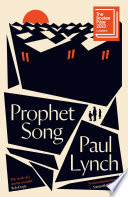
Prophet Song
Paul Lynch, 2023
155 ratings
§ About Paul Lynch's books
- Books on SansFiction
- 1
- Published
- 2023
- Average rating
- 3.9 / 5 across 155 ratings
- Genres
- Dystopian, Fiction, Science Fiction
The book: Prophet Song (2023)
A fearless portrait of a society on the brink as a mother faces a terrible choice, from an internationally award-winning author On a dark, wet evening in Dublin, scientist and mother-of-four Eilish Stack answers her front door to find the GNSB on her step.
Common questions about Paul Lynch
- Who is Paul Lynch?
- Born in Limerick in 1977, Paul Lynch moved with his family at nine months old to rural Donegal, growing up near Inishowen and Malin Head on the northern Irish coast. He later moved to Dublin to study English and Philosophy at University College Dublin.
- What is Paul Lynch best known for?
- Paul Lynch is best known for Prophet Song, published in 2023 with 155 ratings and a 3.9 average. It is the most-rated of Paul Lynch's books on SansFiction.
- What genres does Paul Lynch write?
- Paul Lynch's books on SansFiction are tagged Dystopian, Fiction and Science Fiction.
Explore: Dystopian · Fiction · Science Fiction