PK
§Author· 1 book
Paul Kalanithi
Also known as Paul Sudhir Arul Kalanithi
A profound reflection on mortality and medical ethics, the memoir When Breath Becomes Air provides a rare dual perspective on life, death, and human vulnerability from both sides of the doctor-patient relationship. Written by American neurosurgeon, neuroscientist, and author Paul Kalanithi, the posthumously published work examines what makes a life meaningful in the face of terminal illness.
Diagnosed with stage IV metastatic lung cancer at age thirty-six while completing his medical training, Kalanithi spent his final months writing about his transition from a physician treating deadly neurological diseases to a patient confronting his own mortality. His story gained widespread international recognition, becoming a Pulitzer Prize finalist and a number-one New York Times bestseller.
Career & Background
Paul Kalanithi was born in New York on April 1, 1977, and grew up in Kingman, Arizona, after his family relocated when he was ten years old. He attended Stanford University, graduating in 2000 with a Bachelor of Arts and Master of Arts in English Literature, as well as a Bachelor of Arts in Human Biology. Driven by a deep interest in literature, science, and the humanities, he continued his studies at Darwin College, University of Cambridge, earning an M.Phil. in History and Philosophy of Science and Medicine. He then attended the Yale School of Medicine, graduating cum laude in 2007, where he earned the Lewis H. Nahum Prize for outstanding research and was inducted into the Alpha Omega Alpha medical honor society.
Following medical school, Kalanithi returned to Stanford University for his residency training in neurological surgery alongside a postdoctoral fellowship in neuroscience. Over the course of his medical career, he authored over twenty scientific publications and received the highest research award from the American Academy of Neurological Surgery. In 2013, during his final year of residency, Kalanithi was diagnosed with stage IV lung cancer. Despite his illness, he continued receiving treatment, performing surgical procedures when possible, and writing reflections on medicine and mortality for publications such as The New York Times and Stanford Medicine until his death on March 9, 2015.
Writing Style & Themes
Kalanithi's writing bridges literature, philosophy, and clinical neuroscience, combining analytical rigor with deeply felt human narrative. Rooted in his dual background in English literature and neurosurgery, his prose explores core existential questions regarding how human beings find meaning, hope, and purpose when faced with finite time. By analyzing his experience as both a clinician wielding diagnostic authority and a terminal patient enduring physical decline, his work provides a candid look at the medical profession, doctor-patient communication, and the emotional realities of terminal illness.
Major Works
- When Breath Becomes Air — Published posthumously by Random House in January 2016, this bestselling memoir features a foreword by Abraham Verghese and an epilogue by Kalanithi's widow, Lucy Kalanithi. It details Kalanithi's journey from a literature student to an accomplished neurosurgeon and his subsequent diagnosis with stage IV lung cancer, offering a moving examination of mortality, family, and what makes a life worth living.
§All Books
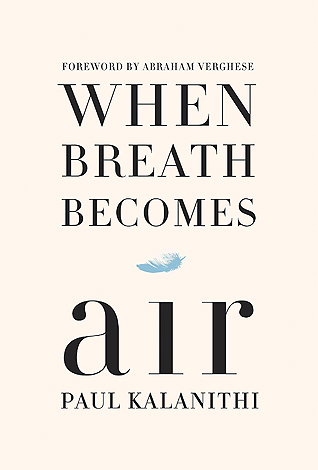
When Breath Becomes Air
Paul Kalanithi, 2016
615 ratings
§ About Paul Kalanithi's books
- Books on SansFiction
- 1
- Published
- 2016
- Average rating
- 4.4 / 5 across 615 ratings
- Genres
- Biography, General, Husband And Wife, Nonfiction
The book: When Breath Becomes Air (2016)
For readers of Atul Gawande, Andrew Solomon, and Anne Lamott, a profoundly moving, exquisitely observed memoir by a young neurosurgeon faced with a terminal cancer diagnosis who attempts to answer the question 'What makes a life worth living?' At the age of thirty-six, on the verge of completing a decade's worth of training as a neurosurgeon, Paul Kalanithi…
Common questions about Paul Kalanithi
- Who is Paul Kalanithi?
- Paul Kalanithi was born in New York on April 1, 1977, and grew up in Kingman, Arizona, after his family relocated when he was ten years old. He attended Stanford University, graduating in 2000 with a Bachelor of Arts and Master of Arts in English Literature, as well as a Bachelor of Arts in Human Biology.
- What is Paul Kalanithi best known for?
- Paul Kalanithi is best known for When Breath Becomes Air, published in 2016 with 615 ratings and a 4.4 average. It is the most-rated of Paul Kalanithi's books on SansFiction.
- What genres does Paul Kalanithi write?
- Paul Kalanithi's books on SansFiction are tagged Biography, General, Husband And Wife and Nonfiction.
Explore: Biography · General · Husband And Wife · Nonfiction