Nathaniel Hawthorne
Also known as Nathaniel Hathorne
Long-form American dark romantic fiction and allegorical short stories established a foundational exploration of colonial history, guilt, and religious orthodoxy, led by key nineteenth-century publications such as The Scarlet Letter. Nathaniel Hawthorne crafted complex narratives that probed the moral tensions of early New England settlement, transforming historical records and Puritan theology into psychological drama. His tales examined secret sin, social judgment, and the lingering influence of ancestral history on individual conscience.
Career & Background
Born in Salem, Massachusetts, on July 4, 1804, he was descended from early Puritan settlers, including John Hathorne, a judge who presided over the 1692 Salem witch trials. To distance himself from this legacy, he altered his surname in his early twenties. He graduated from Bowdoin College in 1825 and anonymously published his first novel, Fanshawe, in 1828. He gained broader public recognition after publishing the short story collection Twice-Told Tales in 1837. To secure financial stability, he worked at the Boston Custom House and briefly joined the Transcendentalist utopian community at Brook Farm. In 1842, he married Sophia Peabody, and the couple resided at The Old Manse in Concord, Massachusetts. He later published The Scarlet Letter in 1850 while living in Salem, followed by The House of the Seven Gables in 1851 during his residency in the Berkshires. After serving as United States consul in Liverpool following a political appointment, he returned to his Concord home, The Wayside, in 1860. He died on May 19, 1864, leaving behind his wife and three children.
Writing Style & Themes
As a prominent figure within the American Romantic movement, his fiction relied heavily on allegory, symbolism, and psychological introspection. Many of his narratives, including short works like Rappaccini's Daughter and novels like The Blithedale Romance and The marble faun, explore the destructive consequences of pride, isolation, and moral rigidity. Rather than treating New England's colonial past as mere historical backdrop, his writing presents moral allegories inspired by Puritan doctrine to examine the human heart's capacity for redemption and corruption. His technique frequently incorporated ambiguous supernatural elements, symbolic artifacts, and detailed examinations of hidden guilt.
Major Works
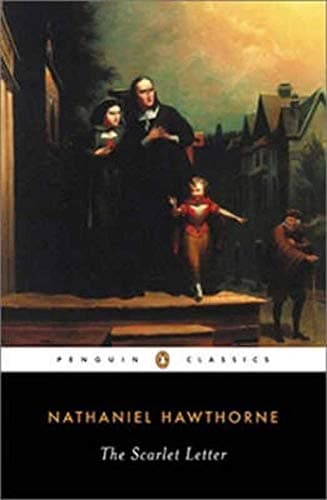
- The Scarlet Letter — Published in 1850, this novel explores sin, guilt, and societal judgment in seventeenth-century Puritan Boston through the story of Hester Prynne.
- The House of the Seven Gables — Published in 1851, this novel traces the legacy of a gabled house in Salem and an ancestral curse affecting the Pyncheon family.
- The Blithedale Romance — Published in 1852, this work draws on the author's experiences at the Brook Farm utopian commune to critique idealist social experiments.
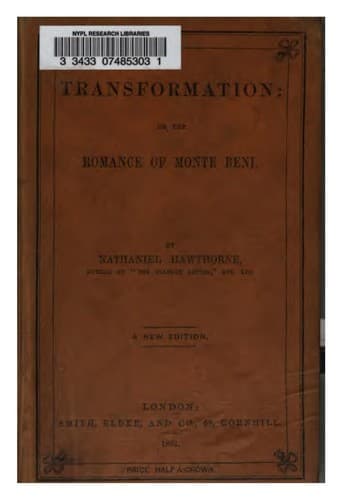
- The marble faun — Published in 1860, this novel set in Rome examines art, innocence, and moral transformation following a fatal crime.
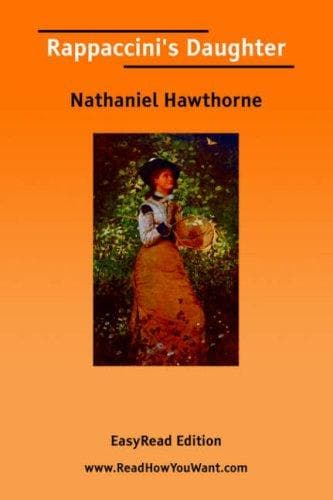
- Rappaccini's Daughter — First published in 1844 and collected in Mosses from an Old Manse, this allegorical short story recounts a scholar's encounter with a poisonous garden.
The Scarlet Letter

The House of the Seven Gables
Rappaccini's Daughter

The Blithedale Romance