
§Author· 1 book
Mark Manson
Modern self-help literature was fundamentally reshaped by counterintuitive personal development books that reject superficial positivity in favor of pragmatic, evidence-backed realism. Mark Manson established himself as a prominent voice in this space through widely read online essays and international bestselling non-fiction works, most notably The Subtle Art of Not Giving a Fck: A Counterintuitive Approach to Living a Good Life*.
His publications have sold over 20 million copies worldwide, achieved translation into more than 65 languages, and reached the top of bestseller lists in over a dozen countries, offering readers a candid framework for navigating emotional health, personal accountability, and modern anxiety.
Career & Background
Raised in Austin, Texas, Manson attended St. Andrews Episcopal School before moving to Massachusetts for higher education. He studied international relations at Boston University, graduating in 2007. Shortly after completing his degree, he began publishing articles online, launching a personal blog in 2010 that eventually expanded into a major self-development platform serving millions of monthly readers and over 500,000 subscribers.
Manson early in his career self-published Models: Attract Women Through Honesty before releasing The Subtle Art of Not Giving a Fck: A Counterintuitive Approach to Living a Good Life* in 2016, which reached number one in fourteen countries. In 2019, he published Everything is Fcked: A Book About Hope*, examining societal despair and cultural values. He also co-authored the 2021 memoir Will with actor Will Smith, and in 2023, Universal Pictures released a feature-length documentary based on Manson's life and ideas.
Writing Style & Themes
Manson's writing style blends frank conversational language, profanity, and direct humor with psychological concepts and philosophical inquiry. Rather than promoting constant optimism, his work emphasizes accepting life's inevitable difficulties, identifying core personal values, and taking responsibility for one's reactions to adversity.
His books and essays critique traditional self-help tropes, advocating instead for realistic decision-making based on science and self-awareness. Key themes across his body of work include emotional resilience, constructive suffering, healthy boundary setting, and confronting the complexities of modern culture.
Major Works
- Everything is Fcked: A Book About Hope* — A #1 New York Times bestseller that analyzes the psychological causes of modern anxiety and societal despair while exploring how to build meaningful hope in a chaotic world.
- The Subtle Art of Not Giving a Fck: A Counterintuitive Approach to Living a Good Life* — A global bestseller published in 2016 that encourages readers to focus on meaningful struggles rather than relentless positivity, later adapted into a 2023 Universal Pictures feature documentary.
- Models: Attract Women Through Honesty — Manson's initial non-fiction release focusing on authentic relationships, self-improvement, and emotional honesty.
- Will — A major biographical project co-authored with actor Will Smith, exploring Smith's career, personal struggles, and self-discovery.
§All Books
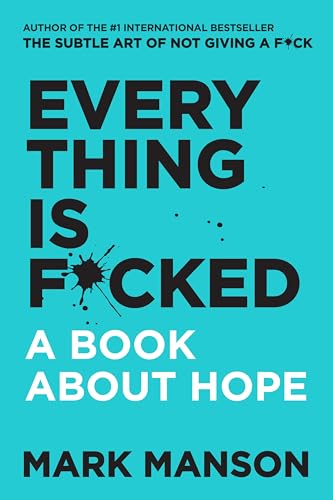
Everything is F*cked: A Book About Hope
Mark Manson, 2019
185 ratings
§ About Mark Manson's books
- Books on SansFiction
- 1
- Published
- 2019
- Average rating
- 3.7 / 5 across 185 ratings
- Genres
- Nonfiction, Parenting & Personal Development, Philosophy, Psychology
The book: Everything is F*cked: A Book About Hope (2019)
Ever wonder why greater connectivity seems to make everyone just hate each other more? Ever wonder why the news always seems so depressing? Ever wonder why people are seemingly becoming more anxious and miserable despite life getting easier? Well, buckle up bitches, Uncle Mark is taking you for another ride.
Common questions about Mark Manson
- Who is Mark Manson?
- Raised in Austin, Texas, Manson attended St. Andrews Episcopal School before moving to Massachusetts for higher education. He studied international relations at Boston University, graduating in 2007.
- What is Mark Manson best known for?
- Mark Manson is best known for Everything is F*cked: A Book About Hope, published in 2019 with 185 ratings and a 3.7 average. It is the most-rated of Mark Manson's books on SansFiction.
- What genres does Mark Manson write?
- Mark Manson's books on SansFiction are tagged Nonfiction, Parenting & Personal Development, Philosophy and Psychology.
Explore: Nonfiction · Parenting & Personal Development · Philosophy · Psychology