
Jonathan Haidt
Also known as Jonathan David Haidt
Inquiry into social psychology and the intuitive roots of human morality has reshaped modern non-fiction discussions around politics, culture, and mental health, notably through bestselling works such as The Anxious Generation: How the Great Rewiring of Childhood is Causing an Epidemic of Mental Illness. Social psychologist Jonathan Haidt has spent decades investigating how emotional instincts precede moral reasoning and why moral communities form opposing ideological tribes.
Career & Background
Born in 1963 and raised in Scarsdale, New York, Haidt earned a B.A. in Philosophy from Yale University in 1985 before completing his M.A. and Ph.D. in Psychology at the University of Pennsylvania in 1992. After completing post-doctoral research at the University of Chicago, he taught for 16 years in the Department of Psychology at the University of Virginia. He later joined New York University's Stern School of Business as the Thomas Cooley Professor of Ethical Leadership, where his research expanded from moral psychology and cultural politics to analyzing how social media impacts teen mental health.
Writing Style & Themes
Haidt combines psychological research, evolutionary concepts, and philosophical principles to explain moral judgment and cultural disagreement. His writing emphasizes that intuitive emotional reactions generally precede conscious rationalization when people evaluate right and wrong. Across his studies of moral emotions, political polarization, and youth mental health, he explores how social institutions, cultural values, and digital environments influence individual psychological well-being and collective social stability.
Major Works
- The Happiness Hypothesis: Finding Modern Truth in Ancient Wisdom — Published in 2006, this book examines ten ancient spiritual and philosophical ideas through the lens of modern psychological science, exploring how balance, virtue, and interpersonal relationships contribute to personal fulfillment.
- The Righteous Mind — Published in 2012 under the full title The Righteous Mind: Why Good People Are Divided by Politics and Religion, this volume explores the intuitive foundations of morality and demonstrates how differing moral matrixes drive political and religious divisions.
- The Anxious Generation: How the Great Rewiring of Childhood is Causing an Epidemic of Mental Illness — This book analyzes the sudden decline in adolescent mental health during the early 2010s, attributing the shift to the transition from play-based childhoods to phone-based childhoods and outlining actionable solutions for families and communities.
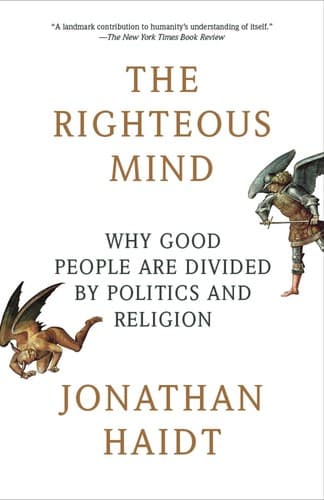
The Righteous Mind

The Anxious Generation: How the Great Rewiring of Childhood is Causing an Epidemic of Mental Illness

The Happiness Hypothesis: Finding Modern Truth in Ancient Wisdom
