
§Author· 1 book
John Knowles
Mid-twentieth-century American coming-of-age fiction was profoundly shaped by wartime boarding school narratives examining youth, rivalry, and moral reckoning. John Knowles established his place in this tradition with A Separate Peace, a 1959 novel set against the backdrop of World War II that became a staple of American literature and academic curricula.
Career & Background
Born on September 16, 1926, in Fairmont, West Virginia, Knowles attended Phillips Exeter Academy in New Hampshire, graduating in 1945. His wartime experiences at the prep school provided the direct inspiration for his early fiction. He subsequently attended Yale University, earning a Bachelor of Arts degree in 1949. Knowles began his professional writing career as a reporter for the Hartford Courant from 1950 to 1952, later working as a freelance writer and serving as an associate editor for Holiday magazine between 1956 and 1960.
Following the publication of A Separate Peace, which earned the William Faulkner Foundation Award, the Rosenthal Award of the National Institute of Arts and Letters, and a nomination for the National Book Award, Knowles transitioned to full-time fiction writing. In addition to his novels, he held academic roles as writer-in-residence at the University of North Carolina at Chapel Hill from 1963 to 1964 and Princeton University from 1968 to 1969. He also taught creative writing at Florida Atlantic University later in his career before passing away on November 29, 2001, near Fort Lauderdale, Florida.
Writing Style & Themes
Knowles's narrative style is characterized by realistic character study, psychological tension, and themes centered on male friendship, internal guilt, and the abrupt loss of youth. Frequently compared to J. D. Salinger for his perceptive focus on adolescent struggle, his work uses exclusive academic institutions as micro-societies reflecting broader world conflicts. His personal papers, archived at Yale University, record his creative process and document literary relationships with contemporaries such as Thornton Wilder and Truman Capote.
Major Works
- A Separate Peace — Published in 1959, this classic novel set at Devon School during World War II explores the intense, tragic friendship between two young students. The book received the William Faulkner Foundation Award and the Rosenthal Award, establishing Knowles's literary reputation.
- Peace Breaks Out — Published in 1981, this companion novel returns to the Devon School setting immediately following World War II, examining post-war disillusionment, rivalry, and unresolved trauma among young men.
- The Paragon — Published in 1971, this novel focuses on a brilliant young veteran navigating personal identity, emotional isolation, and academic pressures as a student at Yale University.
§All Books
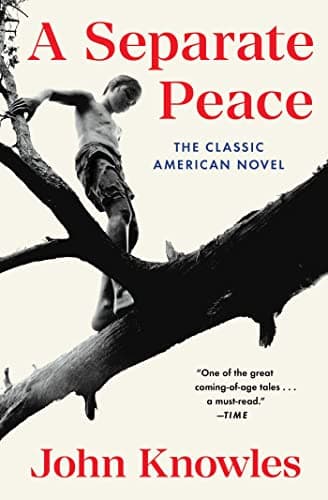
A Separate Peace
John Knowles, 1959
209 ratings