
§Author· 1 book
Jenny Odell
Examining the social and psychological pressures of modern digital culture, non-fiction writing on the attention economy offers critical frameworks for reclaiming focus, agency, and spatial presence. Author Jenny Odell entered this cultural conversation with her best-selling critique How to Do Nothing: Resisting the Attention Economy, which challenges the relentless demands of constant online engagement and productivity metrics.
By interweaving environmental observation, political philosophy, and art history, Odell advocates for a deliberate shift toward local attunement, encouraging readers to reconnect with their physical environments and nonhuman neighbors.
Career & Background
Born in San Francisco, California, in 1986 and raised in Cupertino, Jenny Odell developed an early awareness of the tech-centric culture of Silicon Valley. She pursued higher education at the University of California, Berkeley, and the San Francisco Art Institute, establishing a career as a multidisciplinary artist, writer, and educator based in Oakland, California. From 2013 to 2021, Odell taught Internet art and digital and physical design at Stanford University, guiding students through the creative and social intersections of technology, space, and media.
Odell expanded her artistic and instructional focus into long-form cultural critique with the publication of her 2019 book How to Do Nothing: Resisting the Attention Economy, which became a New York Times bestseller. She followed this work with her 2023 release Saving Time: Discovering a Life Beyond the Clock, alongside essay contributions to publications such as The New York Times, The Believer, and TIME, addressing topics spanning labor, cinema, time perception, and ecology.
Writing Style & Themes
Odell's writing style is characterized by a hybrid approach that bridges self-help, cultural criticism, and political manifesto. Rather than offering straightforward productivity hacks, she draws from ecology, philosophy, film analysis, and visual art to interrogate how economic structures monetize human awareness and time. Her prose frequently highlights personal geography and place-based observation—such as the natural landscapes and urban spaces of the San Francisco Bay Area—to anchor theoretical arguments in tangible, lived experiences.
Central themes across her work include the refusal of capitalist narratives surrounding efficiency, the conceptual history of time as currency, and the necessity of ecological attunement. Odell invites readers to reject the isolating effects of digital platforms by cultivating deep listening, care, and curiosity toward the nonhuman world, offering alternative models for living that prioritize collective wellbeing over economic extraction.
Major Works
- How to Do Nothing: Resisting the Attention Economy — Published in 2019, this New York Times best-selling book formulates a defense of non-productive time and mental space. Drawing on regional natural history, art, and political theory, Odell argues against the invasive design of social media platforms and the relentless drive for economic utility, proposing spatial attunement and community engagement as remedies for digital burnout.
- Saving Time: Discovering a Life Beyond the Clock — Published in 2023, this book investigates the historical construction of time as a commodity tied to labor and profit. Odell explores alternative ways of experiencing time through pre-industrial histories, ecological rhythms, and climate awareness, encouraging readers to reimagine their relationship with schedules and work.
§All Books
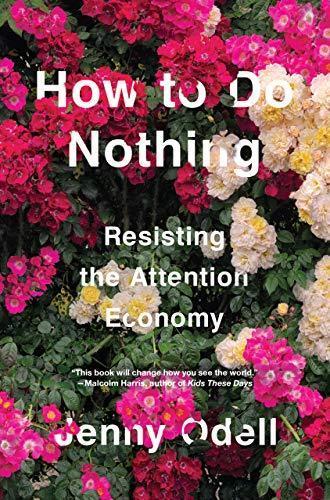
How to Do Nothing: Resisting the Attention Economy
Jenny Odell, 2019
191 ratings
§ About Jenny Odell's books
- Books on SansFiction
- 1
- Published
- 2019
- Average rating
- 3.7 / 5 across 191 ratings
- Genres
- Nonfiction, Philosophy, Politics, Technology & Engineering
The book: How to Do Nothing: Resisting the Attention Economy (2019)
Nothing is harder to do these days than nothing. But in a world where our value is determined by our 24/7 data productivity . . . doing nothing may be our most important form of resistance. So argues artist and critic Jenny Odell in this field guide to doing nothing (at least as capitalism defines it).
Common questions about Jenny Odell
- Who is Jenny Odell?
- Born in San Francisco, California, in 1986 and raised in Cupertino, Jenny Odell developed an early awareness of the tech-centric culture of Silicon Valley. She pursued higher education at the University of California, Berkeley, and the San Francisco Art Institute, establishing a career as a multidisciplinary artist, writer, and educator based in Oakland, California.
- What is Jenny Odell best known for?
- Jenny Odell is best known for How to Do Nothing: Resisting the Attention Economy, published in 2019 with 191 ratings and a 3.7 average. It is the most-rated of Jenny Odell's books on SansFiction.
- What genres does Jenny Odell write?
- Jenny Odell's books on SansFiction are tagged Nonfiction, Philosophy, Politics and Technology & Engineering.
Explore: Nonfiction · Philosophy · Politics · Technology & Engineering