Jared Diamond
Also known as Jared Mason Diamond, Jared M. Diamond
Interdisciplinary popular science and non-fiction history have been profoundly shaped by research into how geography, ecology, and evolutionary biology influence human societies over millennia. American scientist and author Jared Mason Diamond made these broad historical questions accessible through sweeping non-fiction narratives that examine why certain civilizations thrived while others collapsed. Best known for his Pulitzer Prize-winning work Guns, Germs and Steel: A Short History of Everybody for the Last 13,000 Years, Diamond bridges the natural and social sciences to analyze the fundamental environmental causes behind global inequality and human development.
Career & Background
Born in Boston, Massachusetts, on September 10, 1937, Jared Mason Diamond earned his Bachelor of Arts from Harvard University before completing a doctorate in physiology at Trinity College, Cambridge. He began his academic career researching membrane biophysics and digestive physiology, establishing himself as a skilled physiologist. Alongside his laboratory work, Diamond developed a passion for field biology and ornithology, leading extensive research expeditions to study bird populations in Papua New Guinea and the Pacific islands. His interdisciplinary expertise eventually led him to the University of California, Los Angeles (UCLA), where he served as a professor of geography and environmental health sciences, combining evolutionary biology, biogeography, and human history.
Throughout his multi-faceted career, Diamond received major national and international recognition for both his research and public scholarship. In 1998, he was awarded the Pulitzer Prize for General Nonfiction and the International Cosmos Prize, followed by the National Medal of Science in 1999. In 2005, he was selected among the world's top public intellectuals in a poll conducted by Prospect and Foreign Policy magazines, reflecting his broad influence across academic disciplines and popular science writing.
Writing Style & Themes
Diamond's writing is characterized by an integrative approach that synthesizes insights from evolutionary biology, anthropology, physiology, linguistics, and biogeography. Rather than focusing on proximate historical causes such as individual leaders or specific cultural shifts, his work focuses on ultimate geographical and environmental factors. He frequently explores themes of ecological resilience, environmental impact, biological adaptation, and the sustainable management of natural resources, encouraging readers to view human history through the lens of deep time and physical geography.
Major Works
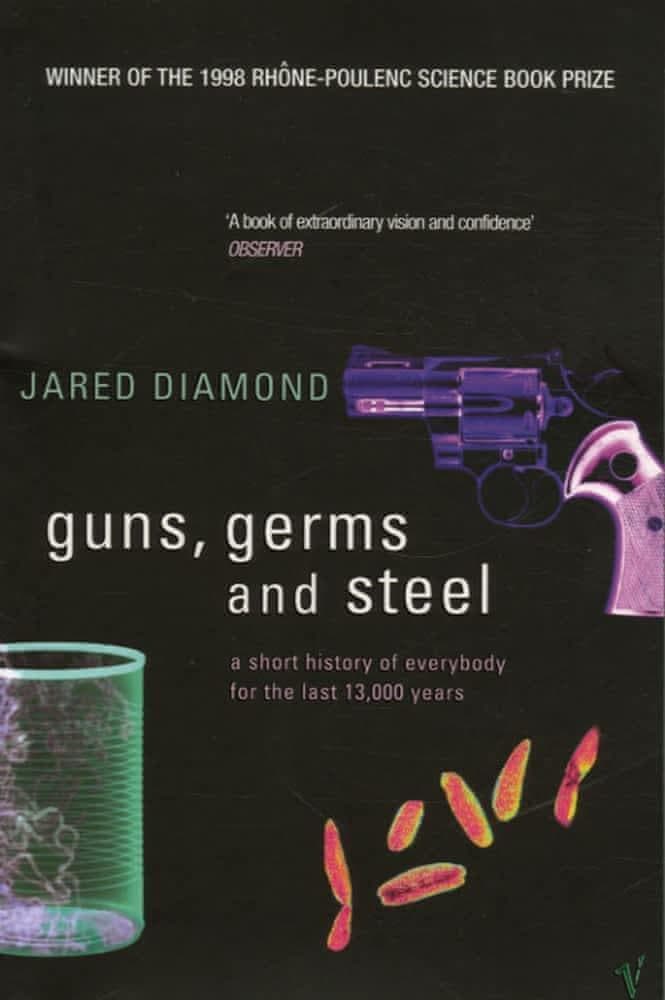
- Guns, Germs and Steel: A Short History of Everybody for the Last 13,000 Years — Published in 1997, this Pulitzer Prize-winning landmark work argues that geographical and environmental factors, rather than intellectual or genetic differences, shaped the unequal distribution of technology and power across human societies throughout history.
- The Third Chimpanzee: The Evolution and Future of the Human Animal — This award-winning 1991 book examines human evolution and behavior, exploring how a tiny genetic divergence from our closest primate relatives enabled humans to develop language, art, agriculture, and civilization alongside destructive traits.
- Collapse: How Societies Choose to Fail or Succeed — Examining historical and modern societies, this 2005 study analyzes how past civilizations collapsed due to environmental degradation, climate change, and flawed decision-making, offering lessons for modern ecological sustainability.
- Why Is Sex Fun? The Evolution of Human Sexuality — Applying evolutionary biology to human physiology and behavior, this book investigates why human sexual practices developed differently from those of nearly all other animal species.
- The World Until Yesterday: What Can We Learn from Traditional Societies? — Drawing on decades of fieldwork in Papua New Guinea, this work compares traditional tribal lifestyles with modern industrialized living across topics such as conflict resolution, elder care, child rearing, and health.