
Hunter S. Thompson
Also known as Hunter Stockton Thompson
By blurring the boundary between objective reporter and active participant, first-person immersive reporting transformed late twentieth-century American non-fiction. Hunter S. Thompson pioneered this immersive approach, creating the subgenre known as Gonzo journalism and capturing countercultural turbulence in works such as Fear and Loathing in Las Vegas: A Savage Journey to the Heart of the American Dream.
Born in Louisville, Kentucky in 1937, Thompson turned assignment reporting into narrative literature by discarding traditional detachment. His breakthrough reporting on motorcycle subcultures in Hell's Angels: A Strange and Terrible Saga established his signature technique of embedding directly within his subject matter to expose the realities beneath American cultural myths.
Career & Background
Thompson began his journalism career while serving in the United States Air Force after high school. Following his military service, he traveled across the country to cover diverse assignments for various newspapers and magazines. In 1965, he spent a year living and riding alongside members of the Hells Angels motorcycle club, an immersive experience that resulted in his 1967 book Hell's Angels: A Strange and Terrible Saga. The success of this publication brought him national attention and established his reputation for firsthand, risk-laden immersion.
In 1970, Thompson covered the Kentucky Derby for Scanlan's Monthly alongside British illustrator Ralph Steadman. Working under deadline pressure, he submitted a stream-of-consciousness draft titled 'The Kentucky Derby Is Decadent and Depraved.' The piece launched the Gonzo style, where the writer's personal reactions and chaotic experiences became the central narrative. Throughout his career, Thompson contributed political and cultural commentary to prominent publications including Rolling Stone, Esquire, Harper's, The Boston Globe, Chicago Tribune, and Playboy.
Writing Style & Themes
Thompson's writing style is defined by an intensely personal, subjective voice that eschewed traditional journalistic claims of detachment and objectivity. By inserting himself directly into his narratives, he utilized satire, dark humor, and muscular prose to critique American political systems, media conventions, and social hypocrisies. His work consistently examined the disillusionment following the 1960s, documenting the collapse of idealism and the deep division between official public narratives and lived reality.
A central element of Thompson's technique was his collaborative pairing with illustrator Ralph Steadman, whose energetic ink drawings mirrored the volatility of Thompson's prose. Rather than delivering polished summaries, Thompson presented erratic, stream-of-consciousness observations that captured the immediate psychological pressure of political campaigns, sporting events, and cultural shifts. Underneath the surreal exaggeration was a persistent effort to expose how political power and authority operated in America.
Major Works
- Hell's Angels: A Strange and Terrible Saga — Published in 1967 after Thompson spent a year living among members of the Hells Angels motorcycle club, this account provided an insider perspective on motorcycle subculture and established his immersive reporting style.
- Fear and Loathing in Las Vegas: A Savage Journey to the Heart of the American Dream — First serialized in Rolling Stone in 1971 and published as a book in 1972, this seminal work of Gonzo journalism follows a drug-fueled trip to Las Vegas, delivering a sharp critique of the decline of the 1960s counterculture.
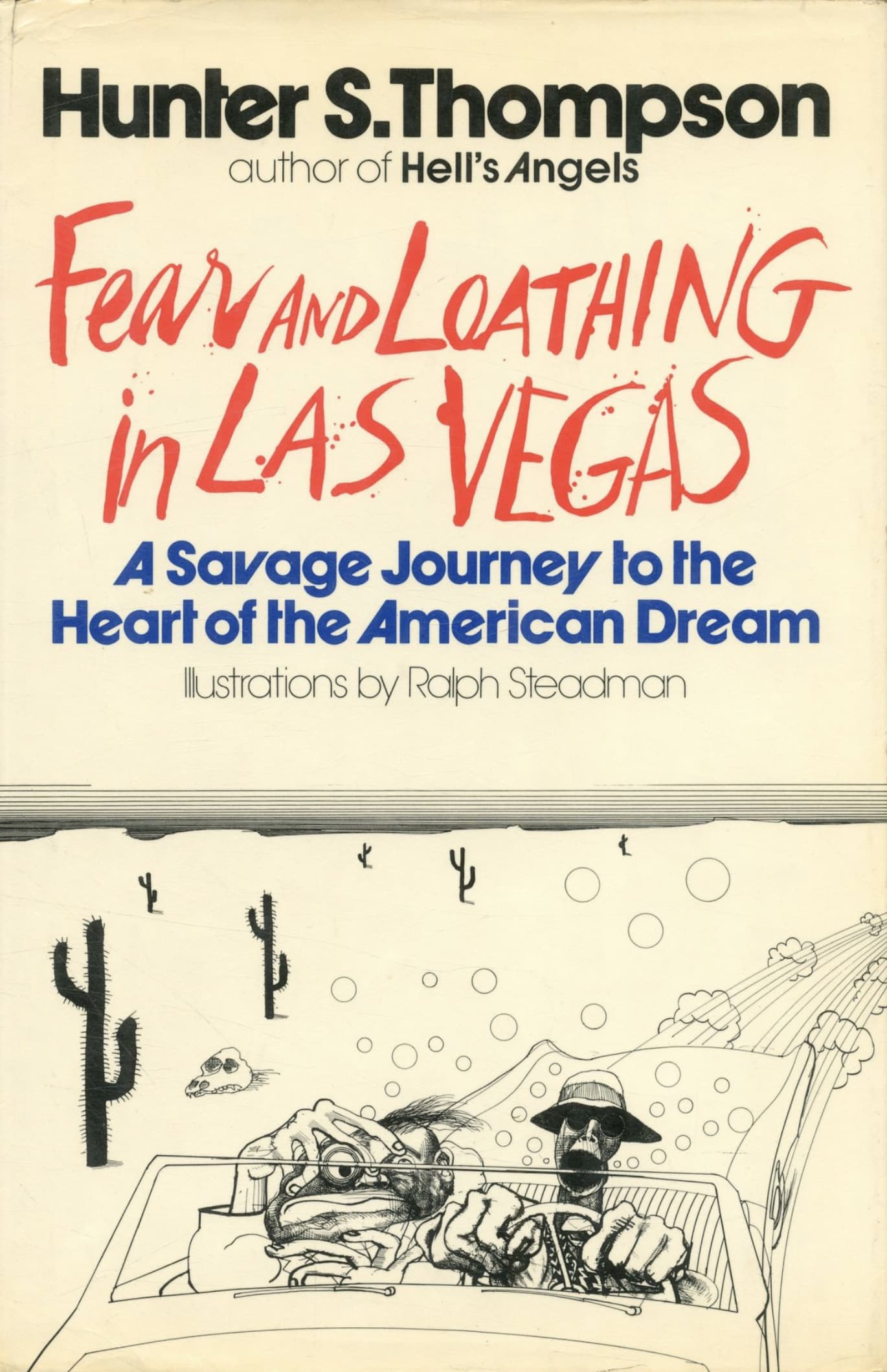
Fear and Loathing in Las Vegas: A Savage Journey to the Heart of the American Dream
