
§Author· 1 book
Edwin A. Abbott
Also known as Edwin Abbott Abbott, Edwin Abbott, A Square, A. Square
Mathematical satire and speculative geometry came together in 1884 with the publication of Flatland, a novella exploring a two-dimensional world whose inhabitants cannot comprehend the third dimension. English schoolmaster, theologian, and clergyman Edwin A. Abbott originally published the work under the pseudonym A Square, crafting a narrative that served as an introduction to higher-dimensional mathematics while delivering a sharp critique of Victorian social rigidity.
Career & Background
Born on December 20, 1838, in Marylebone, London, Edwin Abbott Abbott was educated at the City of London School and St John's College, Cambridge, where he took high honors in classical studies, mathematics, and theology before being elected a college fellow. Ordained as an Anglican priest in 1863, Abbott taught briefly at King Edward's School in Birmingham and Clifton College before becoming headmaster of the City of London School in 1865 at the age of twenty-six. During his twenty-four years leading the institution, he introduced significant educational innovations by incorporating natural sciences and English literature into the standard curriculum. After retiring from his administrative duties in 1889, Abbott spent his remaining decades focused on theological studies, classical scholarship, and literary composition until his death on October 12, 1926, in Hampstead, London.
Writing Style & Themes
Abbott's writing combined rigorous mathematical logic, classical pedagogy, and deep theological reflection. In Flatland, he utilized geometric allegories to investigate human perception, intellectual complacency, and the limitations of sensory knowledge. His fictional world enforces a strict social hierarchy determined by shape and polygon count—where women are simple line segments and social rank increases with the number of geometric sides—allowing him to satirize rigid class structures and religious dogmatism. Beyond his satirical fiction, Abbott produced extensive scholarship on theology, grammar, and early Christian history, including the theological novel Philochristus.
Major Works
- Flatland — First published in 1884 under the pseudonym A Square, this novella describes a multi-dimensional universe and uses a two-dimensional realm to satirize Victorian social structure and examine spatial dimensions.
§All Books
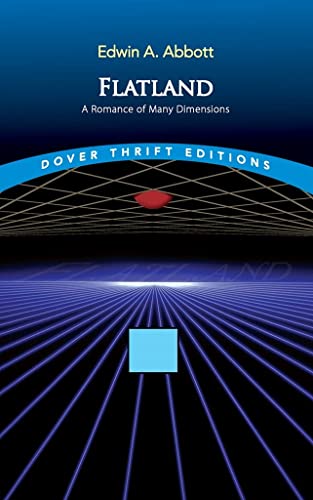
Flatland
Edwin A. Abbott, 1884
283 ratings
§ About Edwin A. Abbott's books
- Books on SansFiction
- 1
- Published
- 1884
- Average rating
- 3.8 / 5 across 283 ratings
- Genres
- Dystopian, General, Historical Fiction, Literature
The book: Flatland (1884)
Flatland: A Romance of Many Dimensions, though written in 1884, is still considered useful in thinking about multiple dimensions. It is also seen as a satirical depiction of Victorian society and its hierarchies. A square, who is a resident of the two-dimensional Flatland, dreams of the one-dimensional Lineland.
Common questions about Edwin A. Abbott
- Who is Edwin A. Abbott?
- Born on December 20, 1838, in Marylebone, London, Edwin Abbott Abbott was educated at the City of London School and St John's College, Cambridge, where he took high honors in classical studies, mathematics, and theology before being elected a college fellow.
- What is Edwin A. Abbott best known for?
- Edwin A. Abbott is best known for Flatland, published in 1884 with 283 ratings and a 3.8 average. It is the most-rated of Edwin A. Abbott's books on SansFiction.
- What genres does Edwin A. Abbott write?
- Edwin A. Abbott's books on SansFiction are tagged Dystopian, General, Historical Fiction and Literature.
Explore: Dystopian · General · Historical Fiction · Literature