
§Author· 2 books
Daniel Suarez
Also known as Leinad Zeraus
Techno-thrillers rooted in real-world computer code, system architectures, and emerging technologies gained a distinct voice with the 2006 release of Daemon, a novel examining how autonomous software programs could reshape global economics and society. American author Daniel Suarez drew on his background in software design to construct high-tech fiction detailing the societal disruptions caused by artificial intelligence, automated drone warfare, and distributed computer networks. His Daemon series, comprising Daemon and its direct sequel Freedom™, established him within modern science fiction and postcyberpunk literature by grounding speculative scenarios in plausible digital infrastructure.
Career & Background
Born on December 21, 1964, in New Jersey, Suarez attended the University of Delaware, where he majored in English literature. He relocated to Los Angeles in the late 1980s and spent nearly two decades working in the software development industry as a systems analyst for Fortune 1000 companies. His extensive technical career designing mission-critical software provided the domain knowledge that later formed the basis for his speculative novels.
Suarez initially entered fiction publishing under the pseudonym Leinad Zeraus, an anagram formed by spelling his full name backward. He self-published Daemon late in 2006 through his own imprint, Verdugo Press, before the novel gained significant traction among technology professionals and science fiction readers. Following the commercial success of Daemon and its sequel, Freedom™, he transitioned into writing full-time and became a public speaker on technological trends and near-future warfare.
Writing Style & Themes
Suarez's writing style bridges technical realism and high-stakes thriller pacing, drawing frequent comparisons to hard science fiction and postcyberpunk traditions. Rather than relying on vague or fantastical technology, he builds narratives around real-world software logic, networking protocols, algorithms, and physical systems infrastructure.
Recurring themes across his novels include artificial intelligence, autonomous drones, augmented reality, dark-net economies, genetic engineering, and deep-space resource extraction. His work consistently analyzes how rapid technological change creates unintended consequences for human political authority, corporate power, and individual freedom.
Major Works
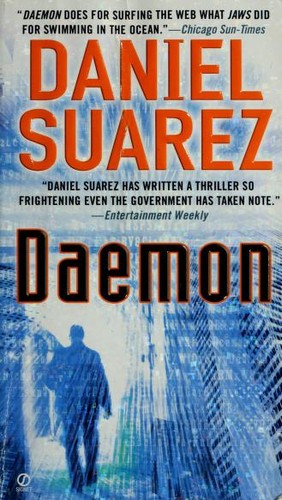
- Daemon — Self-published in 2006, this cyber-thriller follows an autonomous computer program activated upon the death of its creator, which systematically executes code across global networks to disrupt corporate and political systems.
- Freedom™ — The direct sequel to Daemon explores the geopolitical clashes between traditional nation-state authority and the decentralized, high-tech network society created by the autonomous system.
- Kill Decision — Published in 2012, this techno-thriller focuses on autonomous lethal drones, swarm intelligence, and the risks of military systems operating without human oversight.
- Influx — This science fiction novel centers on a clandestine government agency that covertly suppresses revolutionary technological breakthroughs to maintain social stability.
- Change Agent — Set in a near-future world reshaped by advanced biotechnology, this thriller explores human genetic engineering, identity theft, and biological manipulation.
- Delta-v — A hard science fiction narrative detailing a high-stakes commercial asteroid mining operation in deep space and the economic forces driving human off-world expansion.
- Critical Mass — The continuation of the space exploration arc established in Delta-v, examining orbital infrastructure development and deep-space resource utilization.

§ About Daniel Suarez's books
- Books on SansFiction
- 2
- Published
- 2006–2010
- Average rating
- 4.1 / 5 across 537 ratings
- Genres
- Adventure, Dystopian, Fantasy, Science Fiction
- Series
- Daemon
Start here: Daemon (2006)
Technology controls almost everything in our modern-day world, from remote entry on our cars to access to our homes, from the flight controls of our airplanes to the movements of the entire world economy.
Common questions about Daniel Suarez
- Who is Daniel Suarez?
- Born on December 21, 1964, in New Jersey, Suarez attended the University of Delaware, where he majored in English literature. He relocated to Los Angeles in the late 1980s and spent nearly two decades working in the software development industry as a systems analyst for Fortune 1000 companies.
- What is Daniel Suarez best known for?
- Daniel Suarez is best known for Daemon, published in 2006 with 329 ratings and a 4.1 average. It is the most-rated of Daniel Suarez's books on SansFiction.
- How many books has Daniel Suarez written?
- SansFiction lists 2 books by Daniel Suarez, published between 2006 and 2010. The most popular are Daemon and Freedom™.
- What order should I read Daniel Suarez's Daemon books in?
- Read the Daemon books in series order: 1. Daemon, 2. Freedom™.
- What genres does Daniel Suarez write?
- Daniel Suarez's books on SansFiction are tagged Adventure, Dystopian, Fantasy and Science Fiction.
Explore: Adventure · Dystopian · Fantasy · Science Fiction