
§Author· 1 book
Daniel Quinn
Also known as Daniel Clarence Quinn
Philosophical fiction and cultural critique intersected to challenge conventional perspectives on modern civilization through thought-provoking narrative dialogues. American novelist and fabulist Daniel Quinn gained widespread recognition with his 1992 novel Ishmael, which won the Turner Tomorrow Fellowship Award in 1991 for offering creative solutions to global problems.
Through his writing and public speaking at college campuses and social forums, he invited readers to reexamine humanity's relationship with the natural world and rethink fundamental cultural assumptions governing modern society.
Career & Background
Born Daniel Clarence Quinn on October 11, 1935, in Omaha, Nebraska, he graduated from Creighton Prep in 1953. He pursued higher education at Saint Louis University, the University of Vienna, and Loyola University of Chicago, earning a Bachelor of Arts degree in English, cum laude, in 1957. Following his studies, Quinn embarked on a twenty-year career in educational and consumer publishing in Chicago. During this period, he worked as the Biography and Fine Arts editor at the American Peoples Encyclopedia, served as managing editor of the Greater Cleveland Mathematics Program at Science Research Associates, and directed mathematics publishing initiatives.
After decades in publishing, Quinn transitioned to writing full-time and achieved major literary recognition when his manuscript for Ishmael won the Turner Tomorrow Fellowship Award in 1991. He continued to produce fiction, memoirs, and philosophical works until his death from aspiration pneumonia on February 17, 2018, in Houston, Texas, at the age of 82.
Writing Style & Themes
Quinn's work frequently utilizes allegorical and fabulist structures to examine humanity's place in the world, cultural mythology, and historical identity. Rather than adhering to conventional environmentalist paradigms—which he criticized for creating a false dichotomy between humans and nature—he described his overarching philosophy as 'new tribalism.' His narratives invite readers to interrogate deeply ingrained societal beliefs, exploring alternative ways of living and understanding human history.
Across his speculative and philosophical novels, such as After Dachau and The Man Who Grew Young, Quinn examined concepts of personal identity, reversed time, and alternative historical trajectories. His books combine intellectual inquiry with narrative storytelling, challenging readers to consider how cultural narratives shape human behavior and ecological dynamics.
Major Works
- Ishmael — Published in 1992 after winning the 1991 Turner Tomorrow Fellowship Award, this novel uses a dialogue between a human narrator and a telepathic gorilla to examine the ecological and philosophical roots of modern civilization.
- The Story of B — This companion novel expands on the cultural critique introduced in Ishmael, further exploring historical mythology, religion, and human sustainability.
- My Ishmael — Continuing the themes of his award-winning predecessor, this work offers additional perspectives on education, culture, and alternative societal structures.
- Providence — An autobiographical and philosophical work that details Quinn's personal intellectual development, spiritual exploration, and the evolution of his core ideas.
- After Dachau — A novel that raises questions regarding history, personal identity, and cultural assumptions within an alternate historical setting.
- The Man Who Grew Young — A fabulist work centered on the concept of time moving in reverse, illustrating human history from an inverted vantage point.
§All Books
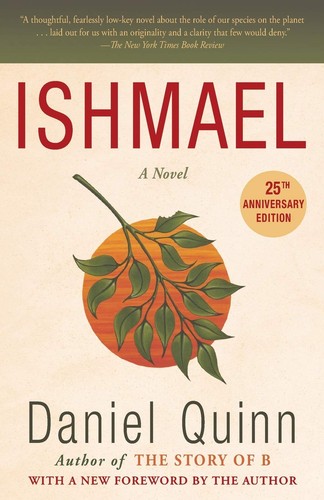
Ishmael
Daniel Quinn, 1992
139 ratings
§ About Daniel Quinn's books
- Books on SansFiction
- 1
- Published
- 1992
- Average rating
- 3.8 / 5 across 139 ratings
- Genres
- Classics, Fantasy, Fiction, Science Fiction
The book: Ishmael (1992)
Common questions about Daniel Quinn
- Who is Daniel Quinn?
- Born Daniel Clarence Quinn on October 11, 1935, in Omaha, Nebraska, he graduated from Creighton Prep in 1953. He pursued higher education at Saint Louis University, the University of Vienna, and Loyola University of Chicago, earning a Bachelor of Arts degree in English, cum laude, in 1957. Following his studies, Quinn embarked on a twenty-year career in educational and consumer publishing in Chicago.
- What is Daniel Quinn best known for?
- Daniel Quinn is best known for Ishmael, published in 1992 with 139 ratings and a 3.8 average. It is the most-rated of Daniel Quinn's books on SansFiction.
- What genres does Daniel Quinn write?
- Daniel Quinn's books on SansFiction are tagged Classics, Fantasy, Fiction and Science Fiction.
Explore: Classics · Fantasy · Fiction · Science Fiction