Bill Bryson
Also known as William McGuire Bryson, William Bryson
Humorous non-fiction and accessible science writing found a widely read expression in books that explain complex topics through observational wit, historical research, and engaging prose, most notably in the popular science bestseller A Short History of Nearly Everything. William McGuire "Bill" Bryson established himself as a versatile Anglo-American author whose work bridges travel narrative, linguistics, and popular science.
His books have earned major international recognition, including the Royal Society's Aventis Prize and the European Union's Descartes Prize, making technical and historical subjects inviting to general readers worldwide.
Career & Background
Born on December 8, 1951, in Des Moines, Iowa, Bryson was raised in a journalism family as the son of sports columnist William Bryson, and he attended Drake University before moving to the United Kingdom in his twenties. He began his professional career in journalism, working for a newspaper in Bournemouth starting in 1977 and later joining the business sections of London publications The Times and The Independent.
Although he spent most of his adult life living in Britain—eventually becoming a naturalized British citizen in 2014—Bryson periodically returned to live in the United States, including a period in Hanover, New Hampshire, between 1995 and 2003. In addition to his writing, he served as chancellor of Durham University from 2005 to 2011 and interviewed Prime Minister Tony Blair in November 2006 regarding science and education.
Writing Style & Themes
Bryson's signature style combines self-deprecating humor, sharp social observation, and accessible summaries of dense information. In travelogues such as Notes from a Small Island—voted in a national poll as the book that best represents Britain—and In a Sunburned Country, he explores regional eccentricities, geography, and cultural identity from an inquisitive outsider perspective.
Beyond travel, his writing frequently examines the mechanics of everyday life, human anatomy, and the historical development of language and science. Works like The Mother Tongue, At Home: A Short History of Private Life, and The Life and Times of the Thunderbolt Kid demonstrate his recurring thematic focus on how historical developments and scientific discoveries shape ordinary human experiences.
Major Works
- A Short History of Nearly Everything — An acclaimed survey of scientific history and discovery that won the Royal Society's Aventis Prize and the Descartes Prize, explaining particle physics, geology, and biology for general readers.
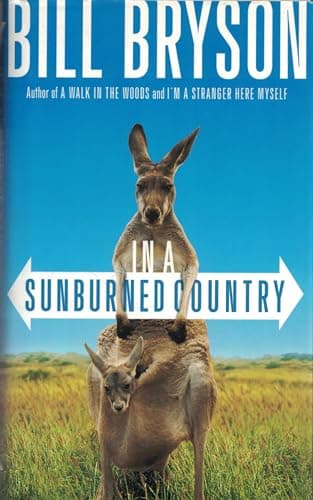
- In a Sunburned Country — A humorous travelogue detailing Bryson's journeys across Australia, examining its unique wildlife, climate, history, and local culture.
- Notes from a Small Island — An affectionate farewell journey around Great Britain that was voted in a national poll as the book that best represents Britain.
- A Walk in the Woods — A classic narrative detailing Bryson's attempt to hike the Appalachian Trail, combining wilderness adventure with environmental and regional history.
- At Home: A Short History of Private Life — A historical exploration using the rooms of a Victorian rectory to trace the evolution of domestic living, architecture, and technology.
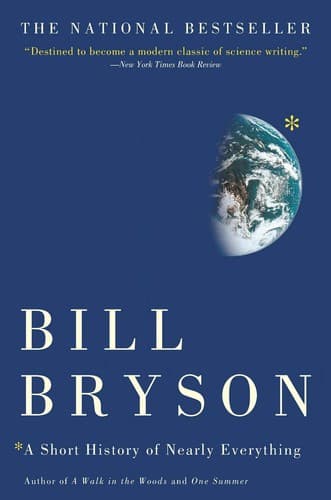
A Short History of Nearly Everything