
§Author· 1 book
Ben Horowitz
Also known as Benjamin Abraham Horowitz, Benjamin Horowitz
Practical management literature often skips the agonizing personal decisions and high-stakes crises that define running an enterprise, focusing instead on theoretical ideals. Ben Horowitz addressed this gap with his New York Times bestseller, The Hard Thing About Hard Things: Building a Business When There Are No Easy Answers, offering an unvarnished examination of executive leadership and startup survival under extreme pressure.
Career & Background
Benjamin Abraham Horowitz was born in London in 1966 and raised in Berkeley, California. He earned a bachelor's degree in computer science from Columbia University before pursuing a career as a technology entrepreneur and executive. He co-founded Loudcloud, an enterprise software business that later became Opsware, serving as president and chief executive officer. Opsware grew into a major enterprise software enterprise before Hewlett-Packard acquired the company for $1.6 billion in 2007, after which Horowitz served as vice president and general manager of Business Technology Optimization for Software at HP.
In 2009, Horowitz co-founded the venture capital firm Andreessen Horowitz alongside Marc Andreessen, helping establish one of Silicon Valley's most prominent investment entities. Beyond his direct investment work, he established the a16z Cultural Leadership Fund to connect cultural leaders with emerging technology companies and support young African Americans entering the technology sector.
Writing Style & Themes
Horowitz's non-fiction writing focuses on operational management, corporate culture, and the psychological burden borne by founders and chief executives. Rather than offering sanitized victory narratives, his books emphasize hard trade-offs, crisis management, and the tactical decisions required during corporate downturns and leadership transitions.
His methodology blends personal leadership experience with historical and cross-disciplinary case studies to analyze organizational dynamics. Through his books and online writing, he maintains that company culture is defined not by corporate statements or perks, but by the practical, daily behaviors and choices modeled by executive management.
Major Works
- The Hard Thing About Hard Things: Building a Business When There Are No Easy Answers — Published in 2014, this New York Times bestseller draws on Horowitz's career as a founder and CEO to offer candid advice on managing startups, handling layoffs, and navigating high-stakes business decisions under severe pressure.
- What You Do Is Who You Are: How to Create Your Business Culture — This bestseller combines historical leadership analysis with modern executive strategy, demonstrating how daily operational choices and cultural standards dictate corporate performance.
§All Books
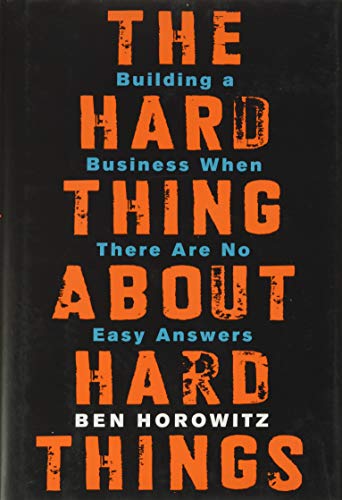
The Hard Thing About Hard Things: Building a Business When There Are No Easy Answers
Ben Horowitz, 2014
194 ratings
§ About Ben Horowitz's books
- Books on SansFiction
- 1
- Published
- 2014
- Average rating
- 4.1 / 5 across 194 ratings
- Genres
- Business & Careers, Business & Economics, Nonfiction, Personal Development
The book: The Hard Thing About Hard Things: Building a Business When There Are No Easy Answers (2014)
A lot of people talk about how great it is to start a business, but only Ben Horowitz is brutally honest about how hard it is to run one. In The Hard Thing About Hard Things, Ben Horowitz, cofounder of Andreessen Horowitz and one of Silicon Valley's most respected and experienced entrepreneurs, draws on his own story of founding, running, selling, buying,…
Common questions about Ben Horowitz
- Who is Ben Horowitz?
- Benjamin Abraham Horowitz was born in London in 1966 and raised in Berkeley, California. He earned a bachelor's degree in computer science from Columbia University before pursuing a career as a technology entrepreneur and executive. He co-founded Loudcloud, an enterprise software business that later became Opsware, serving as president and chief executive officer.
- What is Ben Horowitz best known for?
- Ben Horowitz is best known for The Hard Thing About Hard Things: Building a Business When There Are No Easy Answers, published in 2014 with 194 ratings and a 4.1 average. It is the most-rated of Ben Horowitz's books on SansFiction.
- What genres does Ben Horowitz write?
- Ben Horowitz's books on SansFiction are tagged Business & Careers, Business & Economics, Nonfiction and Personal Development.
Explore: Business & Careers · Business & Economics · Nonfiction · Personal Development