Annie Jacobsen
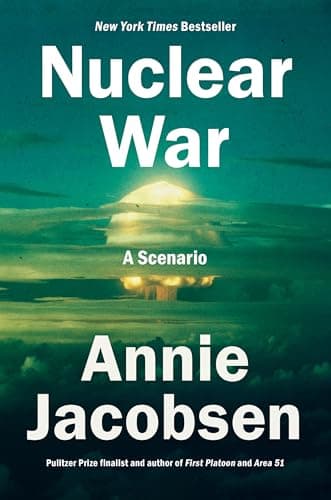
Investigative reporting on national security, government secrecy, and military technological history has provided critical public insight into previously classified programs, most notably in works such as Nuclear War: A Scenario. Annie Jacobsen is an American investigative journalist, author, and Pulitzer Prize finalist whose non-fiction books examine defense technology, intelligence agencies, and covert operations.
Through extensive archival research and interviews with former military and intelligence personnel, her work demystifies complex defense topics ranging from nuclear strategy and secret weapons testing to military research and paramilitary operations.
Career & Background
Born in Middletown, Connecticut, Jacobsen attended St. Paul's School before earning her degree from Princeton University, where she served as Captain of the Women's Ice Hockey Team. She initially spent years pursuing creative writing, focusing on short fiction and novels into her mid-30s before redirecting her literary focus toward non-fiction investigative journalism.
Jacobsen served as a contributing editor for the Los Angeles Times Magazine from 2009 until 2012, writing feature stories on national security and defense issues. Beyond her non-fiction publishing, she has expanded into television production and screenwriting, working as a writer and producer on Amazon Studios's Tom Clancy's Jack Ryan and CBS's Clarice. Her investigative books on federal agencies and defense history have established her prominent standing in national security reporting.
Writing Style & Themes
Jacobsen's writing approach combines primary-source archival research, declassified military records, and extensive firsthand interviews with former military officers, scientists, and intelligence operatives. Her investigative projects frequently address recurring themes of institutional secrecy, weapon development, moral injury in war, and the ethical ramifications of military innovation.
By placing personal human narratives alongside technical defense history, Jacobsen makes intricate military projects and secretive agency histories accessible to general readers. Her narratives systematically unpack long-concealed historical programs, illustrating how executive defense decisions shape global security and public awareness.
Major Works
- Nuclear War: A Scenario — A non-fiction examination detailing the minute-by-minute protocols, defensive capabilities, and command chain procedures triggered during a hypothetical nuclear conflict.
- Area 51 — An investigative history exploring the origin, operations, and top-secret aviation testing conducted at the U.S. military facility in Nevada.
- Operation Paperclip — A detailed chronicle of the covert post-World War II American intelligence program that brought German scientists and engineers to the United States.
- The Pentagon's Brain — A 2016 Pulitzer Prize finalist history of the Defense Advanced Research Projects Agency (DARPA), analyzing its military innovations and secret scientific research.
- Surprise, Kill, Vanish — A historical overview of CIA paramilitary operations and covert actions, tracing the development of specialized operatives and foreign interventions.